Summary & Concepts: The Principle That Wanted to Be Eternal
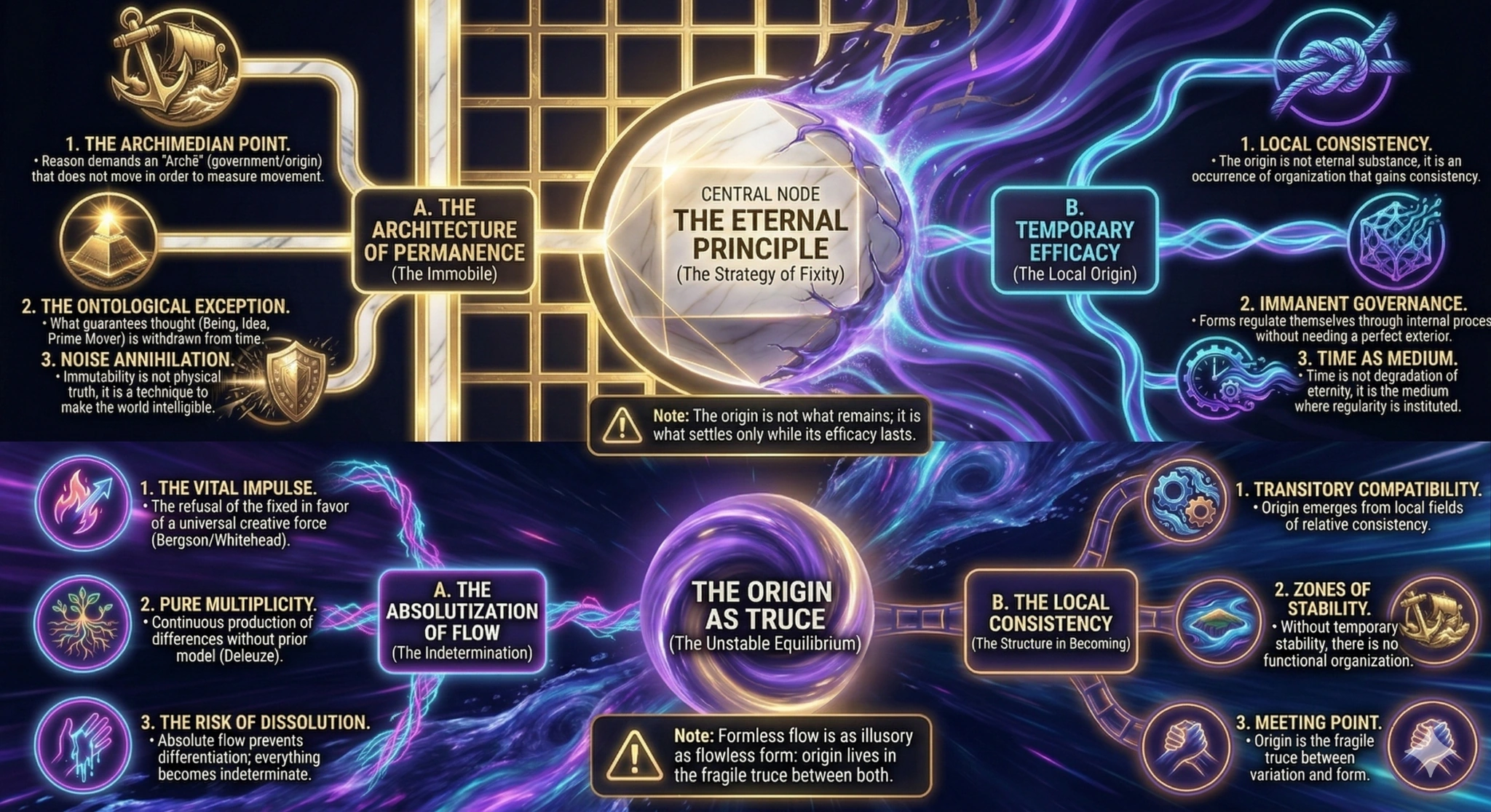
This text analyzes how classical philosophy tried to "tame" the instability of the world by creating the idea of ​​a fixed and eternal Origin. OCE argues that this search for an immobile principle (be it God, the One, or the Laws of Physics) is a strategy to deal with the fear of chaos, but it prevents us from seeing reality as it is: a continuous process without a fixed point.
Summary of Key Points
- The 4 Masks of Origin The text identifies four historical ways of fixing the origin: Ontological (Parmenides), Normative (Heraclitus), Paradigmatic (Plato) and Teleological (Aristotle).
- The Fear of Time All these strategies serve to save knowledge from the corrosion of time. If everything changes, nothing can be known; Therefore, something is invented that does not change.
- Origin as Exception In the classical view, the origin is an exception to the rule: it creates movement, but it does not move; creates time, but is eternal.
- The OCE Proposal The origin is not an exception, it is a local event. Stability is not eternal, it is a temporary achievement of matter.
Concept Map
Essential Definitions
| arché | Greek word for "principle" or "command." The idea that whoever starts also governs. |
|---|---|
| Ontological Exception | The idea that the first cause (God, Big Bang, Laws) is "outside" the system it created and does not obey the same rules. |
| Teleologia | The belief that the universe has a predetermined purpose or end (telos). |
| Imutabilidade | The quality of not changing. For the classics, only what is immutable is true. For OCE, nothing is set in stone. |