Summary & Concepts: The Real Without Witness
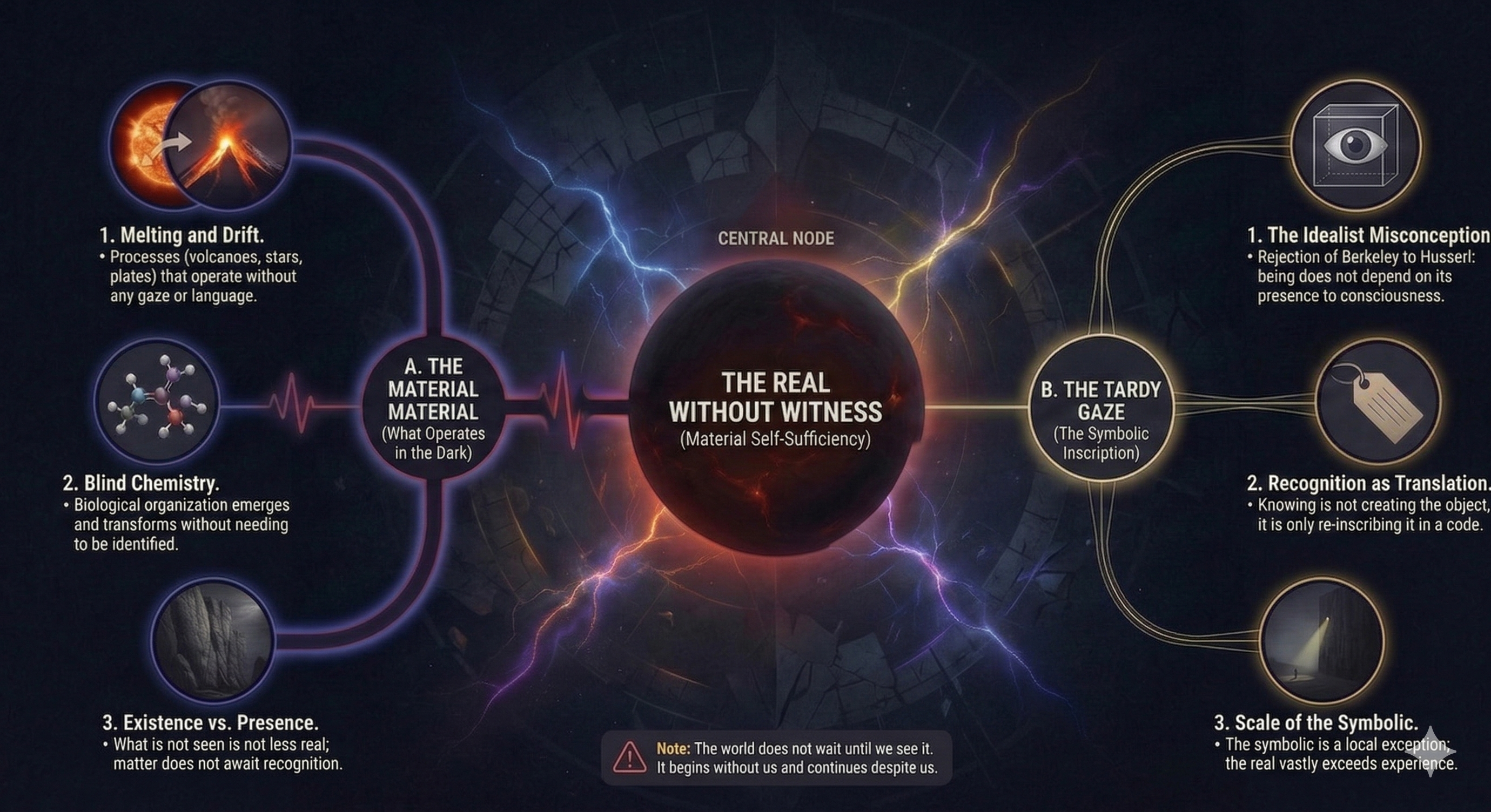
This text establishes the principle of ontological independence: the real exists and transforms without needing to be observed, named or inscribed. OCE breaks here with any form of idealism or correlationism (the idea that the world only exists "for us").
Matter operates alone. Volcanoes erupt, stars are born and die, cells divide, all without any audience. Symbolic recognition is a late and rare event in the universe, not a condition for its existence.
Summary of Key Points
- Material self-sufficiency Matter does not wait for permission to act. Its processes are autonomous and prior to any language.
- Criticism of Idealism The idea that "to be is to be perceived" (Berkeley) is rejected. The universe existed for billions of years without anyone noticing.
- Registration vs. Existence Existence is a brute fact. The inscription (knowledge, science, art) is a symbolic fact. The second depends on the first, but the first does not depend on the second.
- The Excess of the Real The real is always vaster than what we know of it. There is always an "excess" of processes happening outside our radar.
Concept Map
Essential Definitions
| Ontological Independence | The ability of the real to exist and operate without any relationship with a subject, consciousness or system of registration. |
|---|---|
| Correlacionismo | The philosophical thesis (criticized by OCE) that we cannot think about the world without thinking about our relationship with it. |
| Late Registration | The fact that language and thought are recent events in the history of the universe, arriving long after matter was already organised. |
| Excess Occurrence | The idea that infinitely more things happen in the universe than will ever be recorded or known. |