Summary & Concepts: Origin is That Which Becomes Origin
This text presents one of the most paradoxical and powerful theses of OCE: the origin is always retrospective. There is no "zero moment" that is announced as such. What exists is a continuous process of emergence that, only after being stabilized, allows us to look back and say "it started there".
The origin is not a physical fact (like an explosion), but a symbolic inscription. It is the way in which narrative (scientific, religious or philosophical) organises the chaos of the past to make sense of it. The origin does not found the real; the real emerges, and the origin founds the history of this real.
Summary of Key Points
- Origin Retroactivity No one knows you're starting something historic the moment you do it. The status of "origin" is assigned later, by survivors.
- Origin vs. Emergence Emergence is the brute fact (the reorganisation of matter). The origin is the symbolic fact (the naming of this event as foundational).
- Narrative Construction Saying "it all started with the Big Bang" is one way of telling the story, not necessarily the only way of describing reality. The origin is an intelligibility tool.
- The Power of Naming Whoever defines the origin defines the identity. Choosing where the story begins is an act of power (political, scientific or personal).
Concept Map
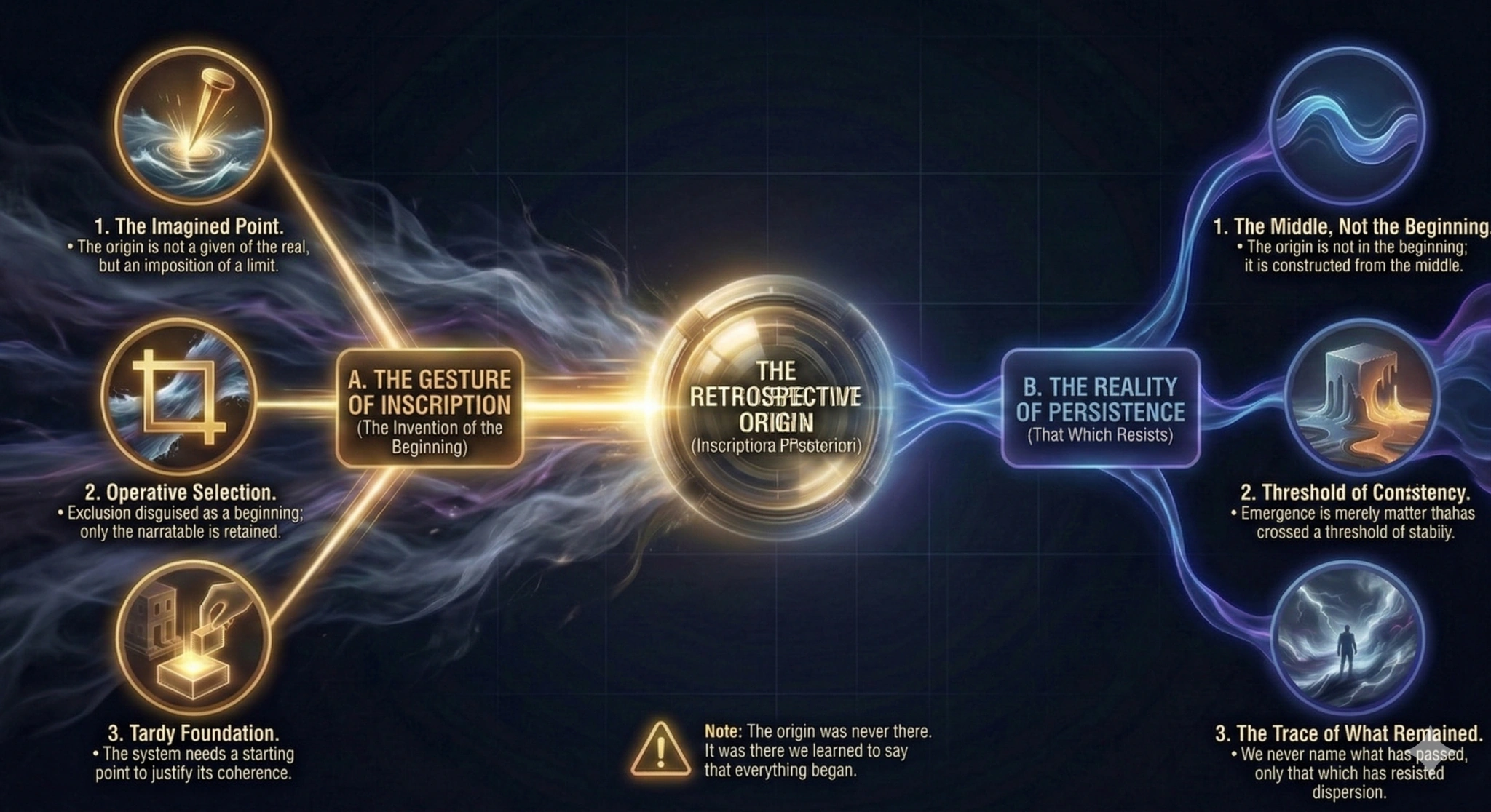
Essential Definitions
| Retrospective Origin | The idea that the beginning is only constituted as such based on its consequences. The effect creates the cause as an explanatory category. |
|---|---|
| Symbolic Inscription | The act of marking, naming, or narrating an event. Origin does not exist in brute nature; it exists in culture and language. |
| Consistency Threshold | The point at which an emergence becomes stable enough to be recognized and named. Before that, it's just noise. |
| Domestication of Time | The use of the origin narrative to control the anguish of chaos. Giving the story a clear start is one way to make it manageable. |