Summary and Concepts: Random Is Not Occasional
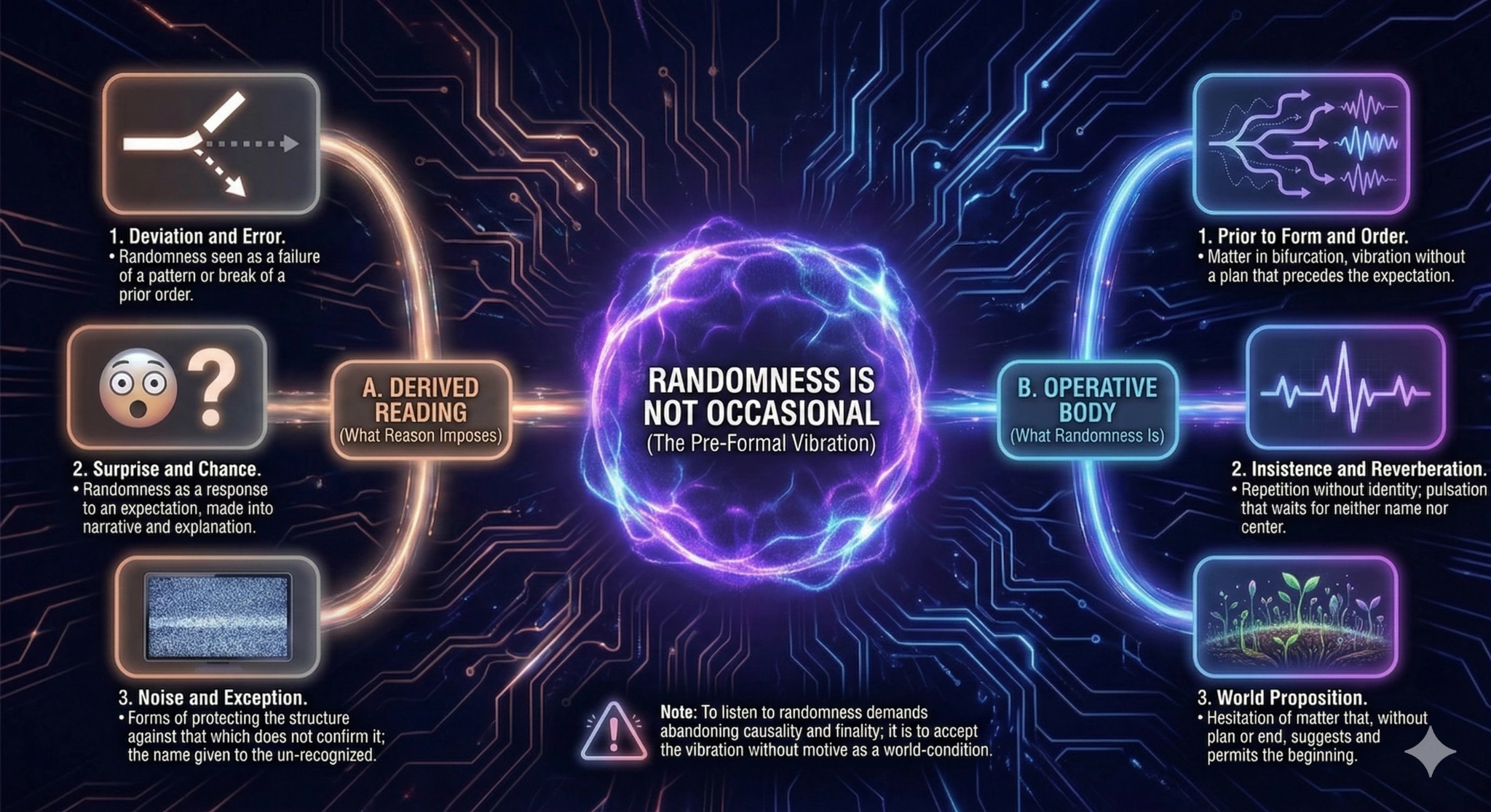
This text redefines the concept of random. Instead of considering it as "chance", "error" or "exception" (categories that depend on a prior order to exist as a deviation), the text proposes randomness as a positive power and primordial. Randomness is the ability of matter to bifurcate before any law.
The central thesis is that randomness is not what happens "by chance" in an ordered world; it is the very bottom of the world. The order is the local exception. The text invites us to "listen" to this vibration without a plan, suggesting that the true creativity of the universe resides in this zone where things still have no name or destiny.
Summary of Key Points
- Random as Background Random is not noise that disturbs the signal; it is the signal itself before encoding. It is the base texture of reality.
- Review of "Acaso" The word "chance" is misleading because it suggests something that is outside the norm. The text argues that there is no rule prior to randomness; it is the condition of possibility of any future rule.
- Bifurcation Power Randomness is defined as the intrinsic ability of matter to explore multiple (possible) paths without any of them being predetermined.
- Listening vs. Explanation The text proposes a change in attitude: instead of trying to "explain" the random (by reducing it to causes), we should "listen to" it as a source of radical novelty.
Concept Map
Essential Definitions
| Random (Ontological) | It is not statistical "chance", but the property of matter of not being fully determined, always maintaining a reserve of indeterminacy and novelty. |
|---|---|
| Bifurcation | The moment when an unstable system can follow multiple different paths, with the choice of path being impossible to predict deterministically. |
| Non-Linearity | The characteristic of systems where small causes can generate large effects (butterfly effect), making prediction impossible and operational randomness. |
| Escuta | Methodological concept proposed by the text: attention to what does not yet have form, refusing the immediate imposition of logical categories. |