Summary and Concepts: Instability as a Condition
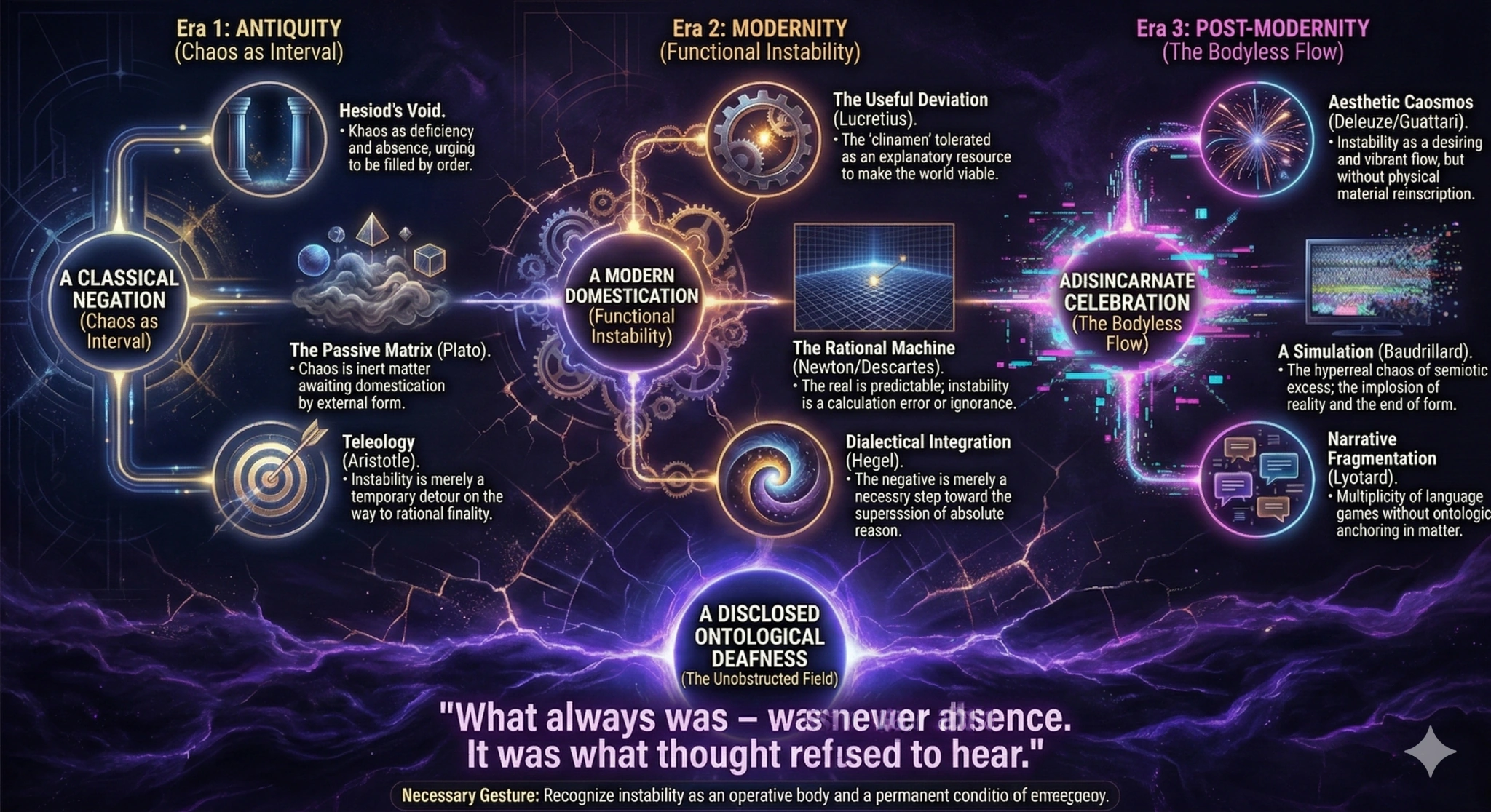
This text operates a critical review of the history of Western philosophy, identifying a "ontological deafness" systematic. From Hesiod to Hegel, and even in contemporary authors, instability (chaos) has always been treated as an interval, a failure or a means to achieve order, never as an autonomous regime of support for reality.
The central argument is that Western thinking has been a long strategy of immunization against the unstable. The origin is always purified (God, Idea, Reason), and when chaos is admitted, it is quickly tamed (as in Kant or Hegelian dialectics). The text proposes that, to found a true Ontology of Complexity, it is necessary to first recognize this structural flaw and learn to listen to instability as operative condition, and not as an absence of form.
Summary of Key Points
- The Refusal of Unstable Origin The philosophical tradition does not tolerate the "beginning" being confusing. Chaos is always a "before" that must be overcome by order (Cosmos).
- Functional Domestication Even when thinkers like Lucretius (clinamen) introduce deviation, they do so to explain freedom or creation, instrumentalizing instability instead of accepting it as the tragic background of reality.
- O Caosmos Desencarnado In postmodernity (Deleuze, Baudrillard), chaos is celebrated, but it often becomes an aesthetic or linguistic concept ("flow", "rhizome") that loses its material and physical gravity.
- Ontological Deafness The diagnostic concept of the text: the structural inability of Western reason to "hear" the background noise of the universe without immediately trying to transform it into music (meaning).
Concept Map
Essential Definitions
| Ontological Deafness | Philosophy's historical inability to recognize instability as a positive and autonomous way of being, always reducing it to a lack of being or a step towards order. |
|---|---|
| Clinamen | Lucretius' concept (the minimum deviation of atoms). In this text, it is criticized for being used only as a "trick" to justify the existence of the world, and not as an affirmation of chaos. |
| Caosmos | Term (from Joyce/Deleuze) that designates a cosmos that is not a closed order, but a composition of flows. The text criticizes certain readings that make this chaosmos purely symbolic. |
| Teleologia | The explanation of things by their end or purpose. The text argues that teleology is the main tool used to silence instability (everything must have a "what for"). |