Origin Without God
The essence of the text lies in demonstrating the unnecessary need for a transcendent creator: physical processes of self-organisation are sufficient to explain cosmological emergence, and radical immanence excludes in principle any external position from which to create.
Summary of Key Points
- Material Self-Organisation Physical processes of self-organisation are sufficient to explain cosmological emergence. The Big Bang is not creation ex nihilo, mas reorganisation of previous physical state. Quantum fluctuations generate universes without a metaphysical first cause.
- Laws as Descriptions Physical laws do not need a legislator - they are names for stabilized material regularities. They do not exist as decrees external to matter, but as abstractions that condense patterns of repeated behaviour.
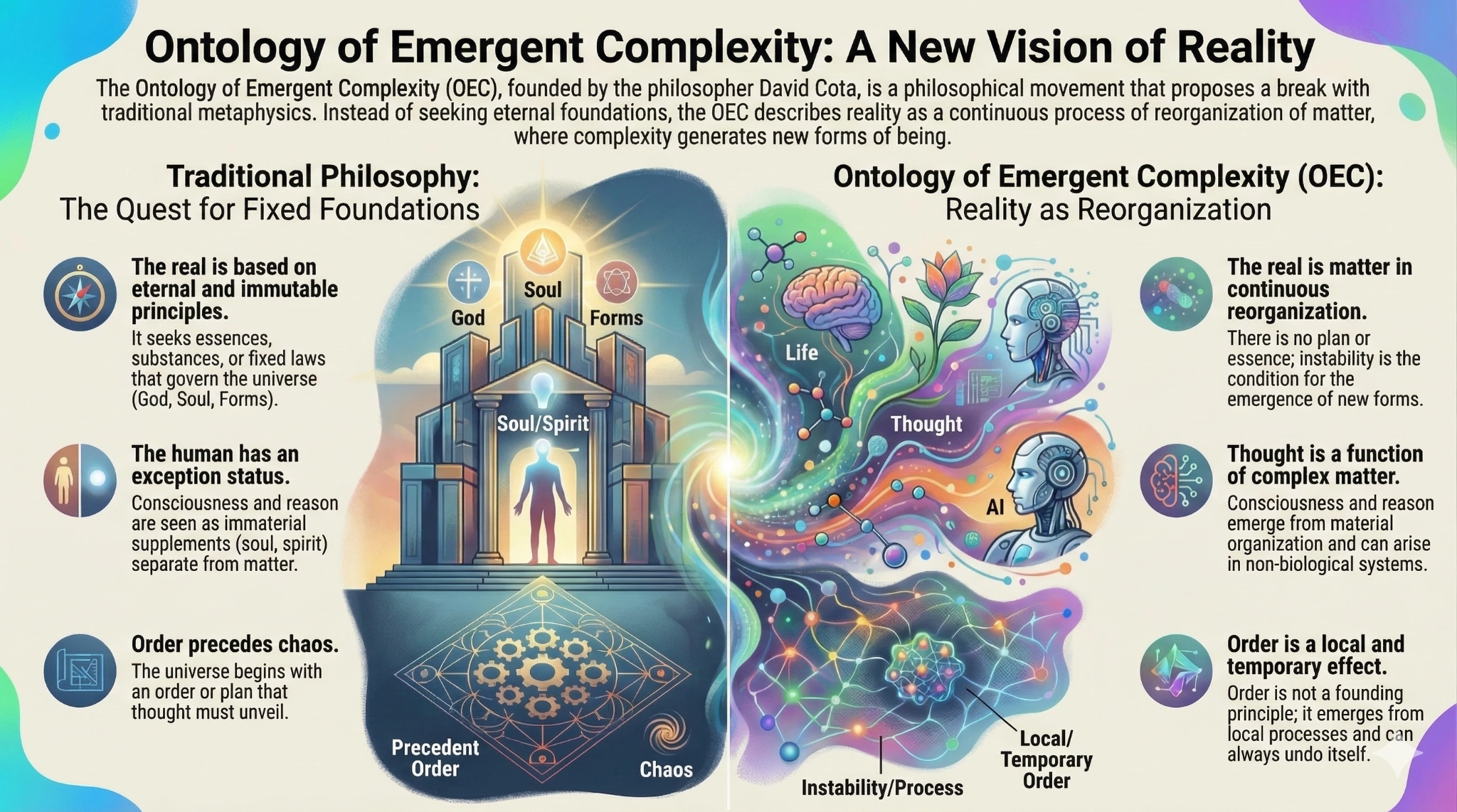
- Radical Immanence The universe is immanent field without exterior. If there is no outside, there is no position from which a creator could operate. Immanence is not a residual negation of transcendence - it is positive affirmation of material sufficiency.
- Refusal of Substantialism Distinguishes from Spinoza: there is no God-Nature as a single substance. There are only multiple material configurations in continuous reorganisation, with no substantial unity that precedes or unifies them.
- "Nothing" as a Category Error "Absolute nothingness" is not an alternative state to being - it is logical impossibility. A state is already something; an alternative is already something. Speaking of "nothing" as a competing hypothesis transforms absence into a positive category.
- Ethics without Transcendence The origin without God implies ethics without external authority: no norm is valid because it derives from a sacred beginning; It is valid only for the way it redistributes possibilities, reduces damage and expands conditions of existence.
Concept Map
Essential Definitions
| Radical Immanence | Structure of the real as a field of relations without an exterior, in continuous reorganisation. There is no outside position from which to operate on the field - only inside. |
|---|---|
| Self-Organisation | Generic property of far-from-equilibrium systems: order emerges from thermodynamic instability without external designer. Complexity arises from local rules, without a global plan. |
| Quantum Creation | Scenario in which the universe arises from quantum vacuum fluctuation. "Nothing" is not an absolute absence, but a quantum state of minimum energy; universe can have zero total energy. |
| Quantum Vacuum | Minimally energetic state that has structure: quantized fields, fluctuations, symmetries. It does not correspond to total absence - it is a material regime with defined properties. |
| Principle of Sufficient Reason | Metaphysical presupposition that everything has a reason for being. Quantum mechanics weakens the strong version: there are statistical reasons, not local deterministic causes for all events. |
| Symbolic Inscription | Way of organising and naming material processes through narratives, equations or models. It is distinguished from the material mark: the inscription symbolically reorganises according to cultural needs. |