The Universe Is Not an Object
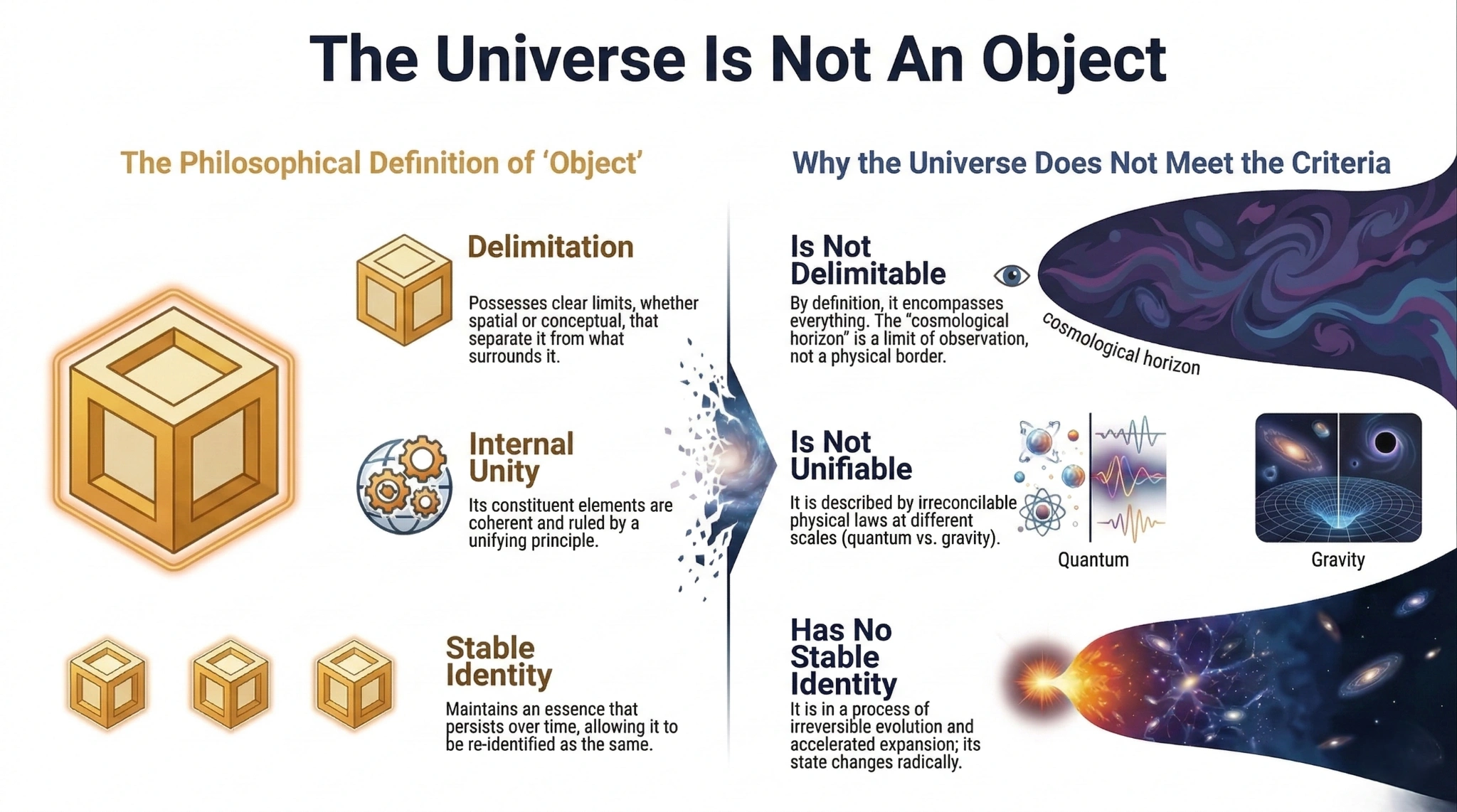
The central thesis states that the category of "object" - defined by the triad of delimitation, unity, identity - is ontologically inadequate to describe the universe as a total relational field. The cosmos is not a thing, but the immanent fabric of material relations.
Summary of Key Points
- The Triad of Objectuality An object, in its paradigmatic condition, has three characteristics: delimitation (limites espaciais ou conceptuais), unidade (internal principle of coherence) and identidade (temporal persistence that allows re-identification). The universe refuses to satisfy any of these criteria.
- The Impossibility of Delimitation The universe is not delimitable. Any limit would require a boundary between something and something else, but the cosmos encompasses everything that physically exists. The cosmological horizon is not a limit of the universe, but a limit to our possibility of receiving information - and each point in space-time has its own horizon.
- The Impossibility of Unification Cosmic reality is fractured by irreconcilable scales: quantum laws seem alien to those of large-scale gravitation. The "hierarchy problem" suggests that unification may be a regulative ideal, not an ontological description. The universe does not have a final architectural principle.
- The Absence of Stable Identity Cosmology tells a story of irreversible evolution: from the initial state of extreme density, through successive phase transitions, to the current era dominated by dark energy. Today's universe is radically different from the universe a second after the Big Bang. There is no static essence; there is a continuous process of transformation.
- Local Object vs. Total Field The distinction between local object (galaxy, star, organism) and total field is not one of magnitude, but of an ontological nature. The local object is a emergent effect of relationships that acquire relative autonomy and persistence. The total universe is the condition of possibility of all relationships - has no exterior of contrast.
- The Cosmological Dissolution Contemporary cosmology dissolved objectification in four acts: (1) abandonment of the static universe (Einstein → Friedmann → Hubble); (2) cosmological principle and FLRW metric; (3) cosmic inflation (Guth); (4) discovery of accelerated expansion and dark energy (Riess, Perlmutter, Planck).
Concept Map
Essential Definitions
| Objeto | Entity that has determinable limits, coherent internal unity and stable identity over time. The delimitation - unity - identity triad founds objectuality from Aristotle to modern philosophies of substance. |
|---|---|
| Total Relational Field | The universe as a condition of possibility for all relationships. It is not a container that contains, nor a homogeneous content, but the immanent fabric of material interactions without an exterior or final architectural principle. |
| Cosmological Horizon | The maximum sphere from which light has been able to travel to a specific observer since the beginning of the observable universe. It is not a physical limit of the cosmos, but a limit to our possibility of receiving information. Each point in space-time has its own horizon. |
| Objeto Local | Pattern of relational stability that acquires relative autonomy and persistence. Emergent effect of functional couplings (mainly gravitational) that behaves as a unit in the face of external interactions. Examples: galaxies, stars, organisms. |
| Cosmic Inflation | Exponentially accelerated expansion phase in the first moments after the Big Bang (≈10â»Â³â¶ seconds). It implies that the observable universe is an infinitesimally small region of an immeasurably larger and, by causal principle, inaccessible total domain. |
| Energia Escura | Form of positive-density energy with negative pressure that constitutes about 68% of the energy content of the universe and causes accelerated expansion. It confirms that the universe does not tend towards a static final state. |
| Erro Categorial | The projection onto the total relational condition (universe) of categories valid only for local configurations (objects). Treating the universe as an object generates insoluble aporias about limits, exterior and totality. |