Space Is a Tense Body
Space is not a neutral container, but a permanently tensioned field of opposing forces. This constitutive tension is the condition of all material differentiation and all symbolic legibility of the cosmos.
Pontos-Chave
- 1. Space is not a neutral container Space is not an empty stage where events occur, nor a pure form that precedes matter. It is a permanently tensioned field of opposing forces in dynamic balance. The tension does not disturb the space; tension is space.
- 2. Break with philosophical tradition From Plato to Kant, space was thought of as a neutral structure, prior to material configurations. Contemporary cosmology has dissolved this conception: space emerges with matter, curves, expands, tightens.
- 3. Cosmological tension: expansion vs. gravity The universe is a field of permanent tension between expansion (which stretches space) and gravity (which resists locally). The discovery of the acceleration of expansion (1998) intensifies this cosmic tension.
- 4. Local tension: pressure vs. collapse In stars, tension manifests itself as a dynamic balance between thermal pressure (which pushes outward) and gravitational collapse (which pulls inward). This balance is not rest, it is permanent tension.
- 5. Quantum vacuum: tension in the "void" Even empty space is tensioned. The quantum vacuum is a field of permanent fluctuations. The Casimir effect demonstrates that the vacuum has an active physical structure and exerts measurable forces.
- 6. Voltage as a condition for readability Tension creates gradients, gradients create material marks, and marks allow symbolic inscription. Without tension, space would be homogeneous and unreadable. The legibility of the cosmos presupposes its constitutive tension.
- 7. Voltage vs. Voltage instability Tension is permanent and constitutive of space. Instability is temporal and characterizes particular forms. The tension crosses the forms but is not identified with any.
Concept Map
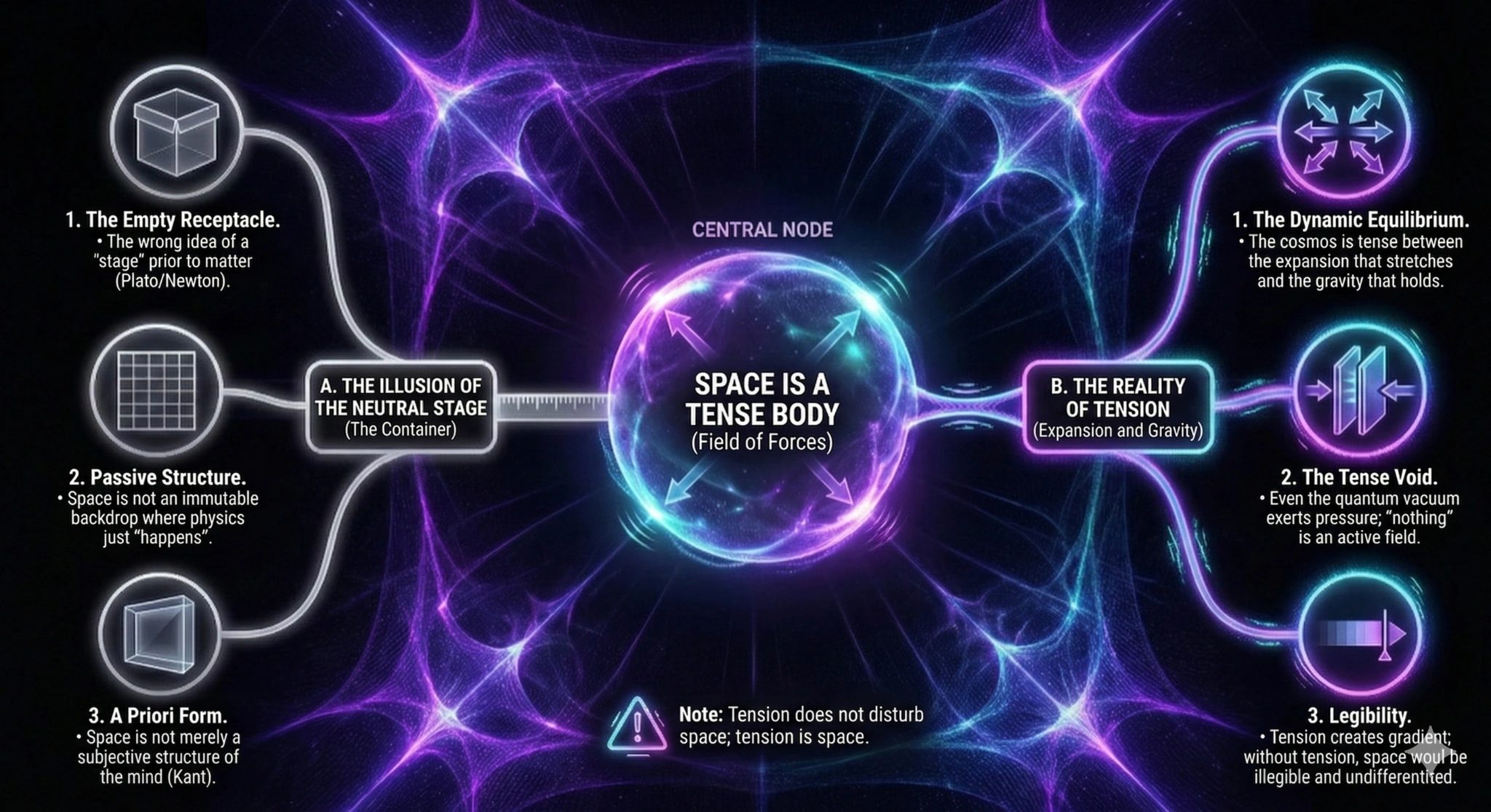
Diagram of the conceptual relationships between spatial tension, cosmological scales and symbolic legibility.
Essential Definitions
| Corpo tenso | Differentiated material configuration permanently tensioned by opposing forces in dynamic balance. Space is a tense body because it is a field of permanent tension, not a bounded substance at rest. |
|---|---|
| Coemergence | Simultaneous emergence of space and matter, without ontological precedence of one over the other. There is no "first space, then matter"; there is only a tense field where both are inseparable aspects. |
| Cosmological tension | Permanent opposition between space expansion (which pushes cosmic structures away) and gravitational cohesion (which resists locally). This tension is constitutive of the universe on all scales. |
| Hydrostatic balance | Tension between internal pressure (thermal or quantum) and gravitational collapse in a star. It is not rest but permanent tension that maintains the stellar configuration for billions of years. |
| Quantum vacuum | Minimum (but not zero) energy state of space, characterized by permanent fluctuations of virtual particles. It is not absolute "nothing" but an active field with a measurable physical structure. |
| Gradiente | Material differentiation produced by spatial tension (density, temperature, curvature). Gradients are a condition for the possibility of legibility: without gradients, there are no marks to symbolize. |
| Marca material | Differentiated physical organisation of matter that can be inscribed symbolically. The mark is not a symbol, but a material difference made legible by a subsequent symbolic operation. |
| Voltage vs. instability | Tension is permanent and constitutive of space; instability is temporal and characterizes particular forms. The tension runs through the forms but is not identified with any specific configuration. |