Summary & Concepts: The Beginning That We Wanted to Cut
This text analyzes modernity's obsession with the idea of ​​"cutting" or "breaking". From Descartes (who doubts of everything to start from scratch) to Kant (who seeks the a priori conditions of knowledge), philosophy modern tried find an absolute starting point, clean of all the past.
OCE argues that there are no absolute cuts. Every beginning is a "suture": a mixture of things new and old. The foundation is not a ground zero, it is a rearrangement of what already exists.
Summary of Key Points
- The Myth of the Pure Foundation The idea that we can Erasing the past and starting again (in science, politics, philosophy) is a modern illusion.
- Descartes e o Cogito "I think, therefore I am" it was a attempt to find an indubitable fixed point. But even this point depends on language and history.
- Corte vs. Sutura Instead of seeing the change like a radical cut, OCE sees it as a suture: stitching together old elements in a new way.
- Continuidade Material The matter never begins of zero. She transforms. Newness emerges from complexity, not from nothing.
Concept Map
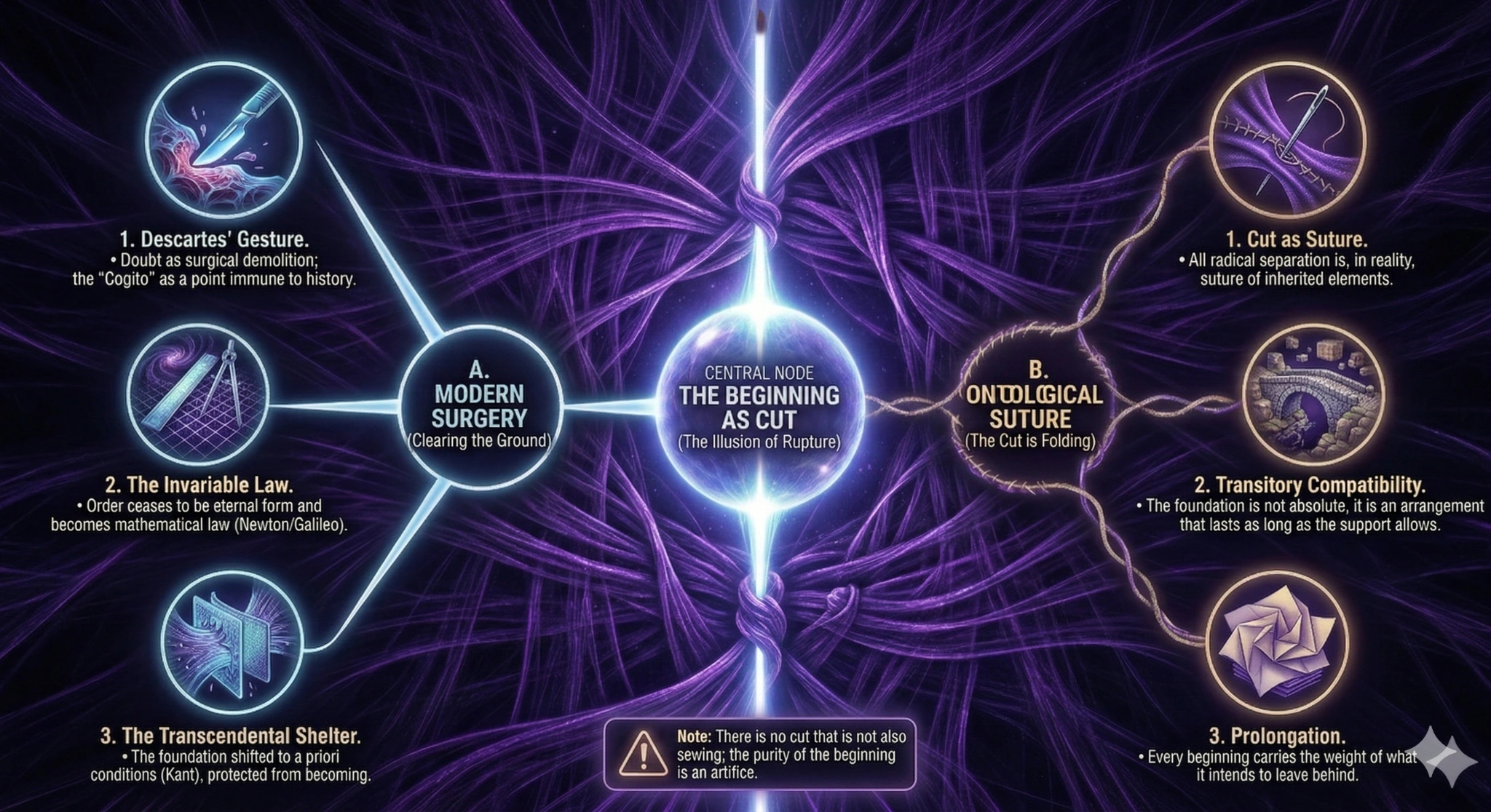
The deconstruction of the idea of ​​absolute rupture.
Essential Definitions
| Epistemological Cut | The idea (popularized by Bachelard) that science advances by radically breaking with the common sense and the past. |
|---|---|
| Fundacionismo | The philosophical search for an unshakable foundation for knowledge. |
| Sutura | OCE concept: the union of disparate elements to create a new continuity. The opposite of cut. |
| Transcendental | In Kant, the universal conditions (such as Space and Time) that make experience possible. A OCE sees them as evolutionary habits, not as absolutes. |