Summary & Concepts: Excess as a Creative Matrix
This text proposes a new answer to the old question: "what makes the world change?". The answer of OCE is: o excesso. Change does not happen because something is missing (lack) or because there is a objective to to achieve (purpose), but because matter produces more relations than the current form can contain.
Excess is, therefore, a "positive surplus": it is energy, information or matter that overflows and forces the system to reorganise itself.
Summary of Key Points
- Change by Overflow The change occurs when local interactions accumulate until they exceed the system's stabilization capacity.
- Refusal of Negativity Unlike Hegel (where the change is born from contradiction/negation), in OCE change is born from affirmation/excess.
- Matriz Criativa Excess is not trash; is the matter prime of innovation. It is in what is "left over" that the possibility of creating something new lies.
- Immanence The engine of change is within the own system, not outside it (like a God or a Destiny).
Concept Map
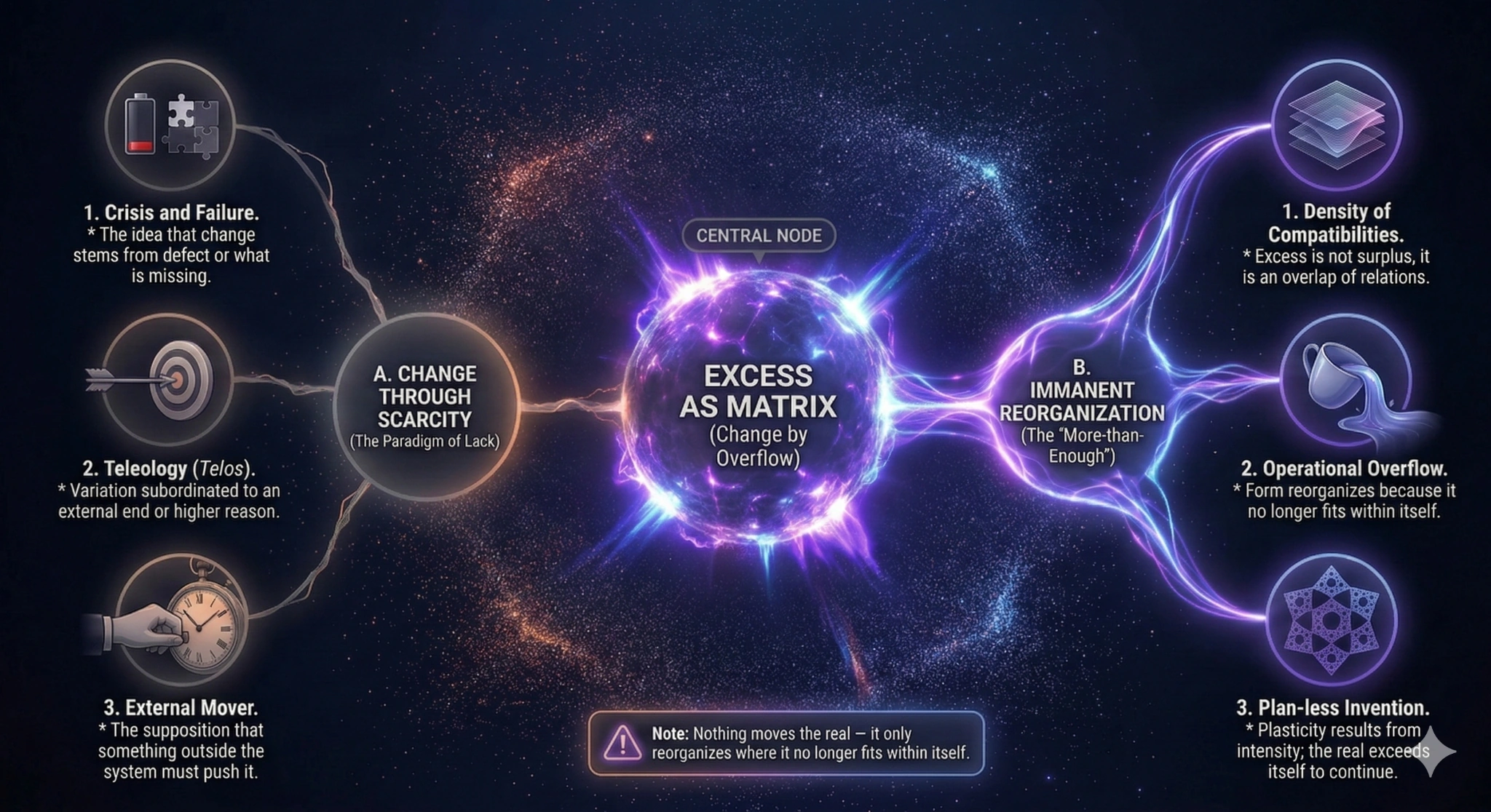
The cycle of accumulation, overflow and reorganisation.
Essential Definitions
| Excesso | The amount of interactions, energy or matter that exceeds the organisation capacity of a system, forcing him to change. |
|---|---|
| Matriz Criativa | The functional role of excess: not as a destroyer, but as a generator of new forms. |
| Reorganisation | The system's response to excess: creating a new structure capable of integrating new interactions. |
| Teleologia | The idea that change is guided by an end or objective (refused by OCE). |