Summary & Concepts: Emergence Without Language
This text deepens the thesis of ontological independence, focusing specifically on the relationship between ordem e linguagem. OCE argues that order (patterns, structures, functions) emerges spontaneously from matter without the need for any code, plan or prior language.
Language is rigorously defined as a recursive system of signs, distinguishing it from mere exchanges of signs or physicochemical reactions. The confusion between "material communication" and "language" is a categorical error that OCE seeks to correct.
Summary of Key Points
- Order without Code Crystals, dunes and stars have form and structure, but they have no "code". Its order is the direct effect of physical forces, not symbolic instructions.
- Communication vs. Language Bacteria communicate (exchange chemical signals), but they do not speak (they do not use recursive symbols). Communication is common in nature; language is rare.
- Ontological Interval There is a qualitative difference (not just degree) between material processes and symbolic processes. Material emergence is the rule; symbolic emergence is the exception.
- Criticism of Pansemiotism The idea that "everything is a sign" trivializes the concept of sign. If everything is language, then language has nothing special.
Concept Map
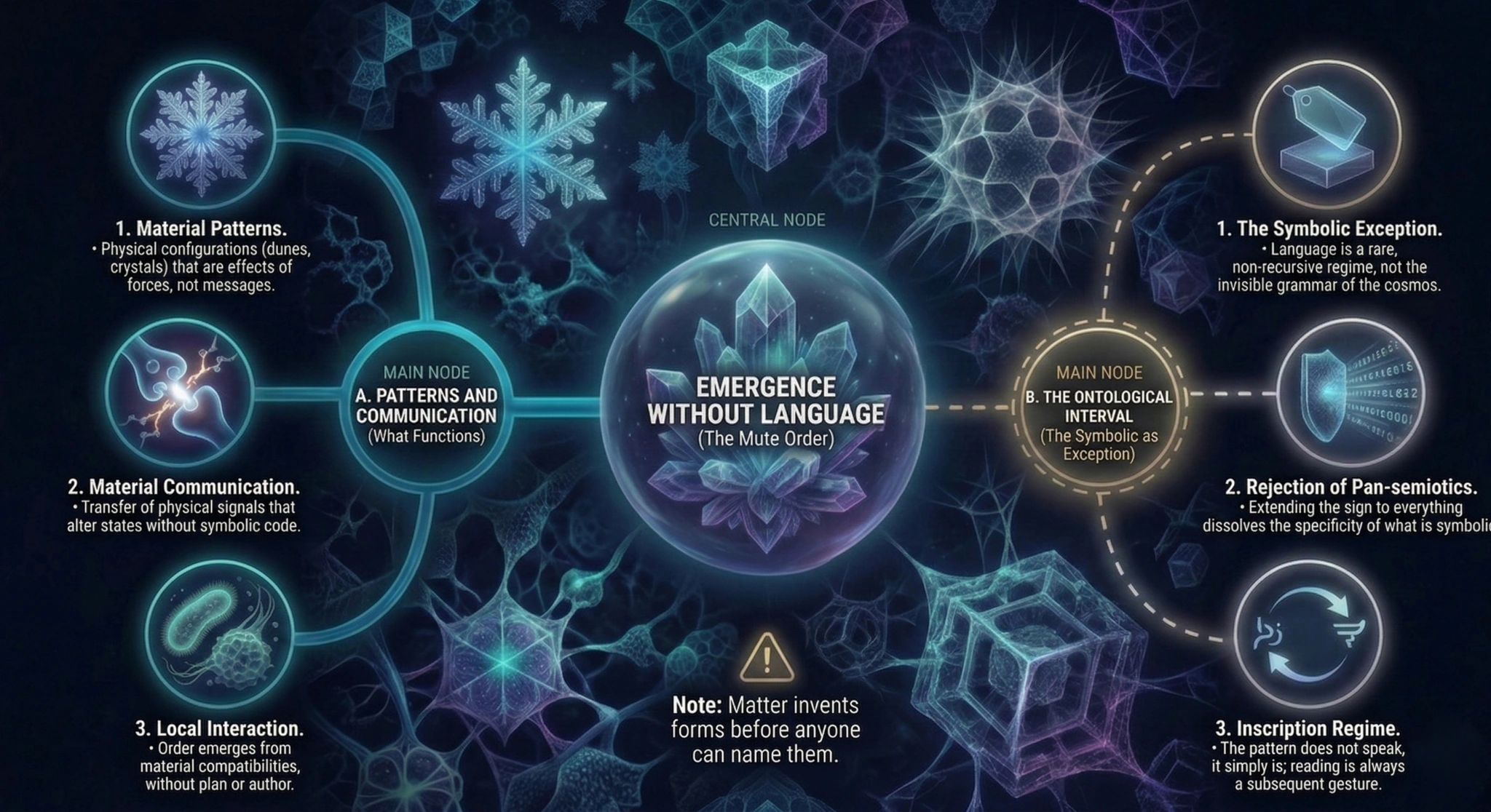
Essential Definitions
| Material Standard | A structural or functional regularity that emerges from physical interactions (e.g. a snowflake), without any semantic content. |
|---|---|
| Material Communication | Transfer of energy or signals that trigger responses (e.g. pheromones), without involving symbolic representation. |
| Linguagem (Sentido Estrito) | System of signs capable of recursion (talking about speech) and negation. Exclusive to highly complex systems. |
| Totalizing Biosemiotics | The theory (criticized here) that sees all biological processes as interpretive processes of signs. |