Summary and Concepts: Rhythm Without an Observer
This text describes the transition from primordial instability to the formation of the first large cosmic structures (galaxies, stars and planets). The driving force is not a prior plan, but the gravidade operando localmente, which concentrates matter into nuclei capable of resisting thermal dispersion. The principle is defined here that the estabilidade precede a forma: it is not the form that organises matter, but the minimum stability of fluctuations that allows the emergence of form.
The central concept is the Polyrhythm. The universe is organised into multiple rotation and orbit regimes that are not synchronized with each other (there is no harmony of the spheres), but that coexist. The Ritmo strictly defined as physical repetition of possible trajectories, without any symbolic or conscious component. Orbits happen, but "no one hears them."
The thesis culminates in the ontological distinction between Rhythm and Time. Rhythm is material and mute; Time requires inscription, counting and symbol. As such, in this cosmological phase, time does not yet exist as an operative category, although the physical cycles are already in full operation. It is a cosmos of pure movement, prior to language.
Summary of Key Points
- Gravity as Local Organizer Matter ceases to be pure dispersion when small fluctuations in density take on "gravitational form", creating nuclei that resist entropy.
- Ontological Inversion (Stability > Form) Form is not a mold imposed on matter. On the contrary, form emerges only where matter reaches a minimum stability that allows it not to dissipate.
- Emergence without Purpose Galaxies and stellar systems emerge as "complex aggregation systems" without a plan or symbolic unity, only through functional reorganisation.
- Material Rhythm (No Registration) Rhythm is defined as the repetition of physical configurations (orbits, rotations) that are maintained by internal dynamics, without the need for an observer or consciousness.
- Polyrhythm The universe is not a single clock. It is composed of multiple repetition regimes that diverge in speed and intensity, coexisting without central unification.
- Time as Absence The text postulates that time requires "listening" and "symbol". As such, in a mute universe, there are cycles and duration, but "time" (as meaning) is not yet born.
Concept Map
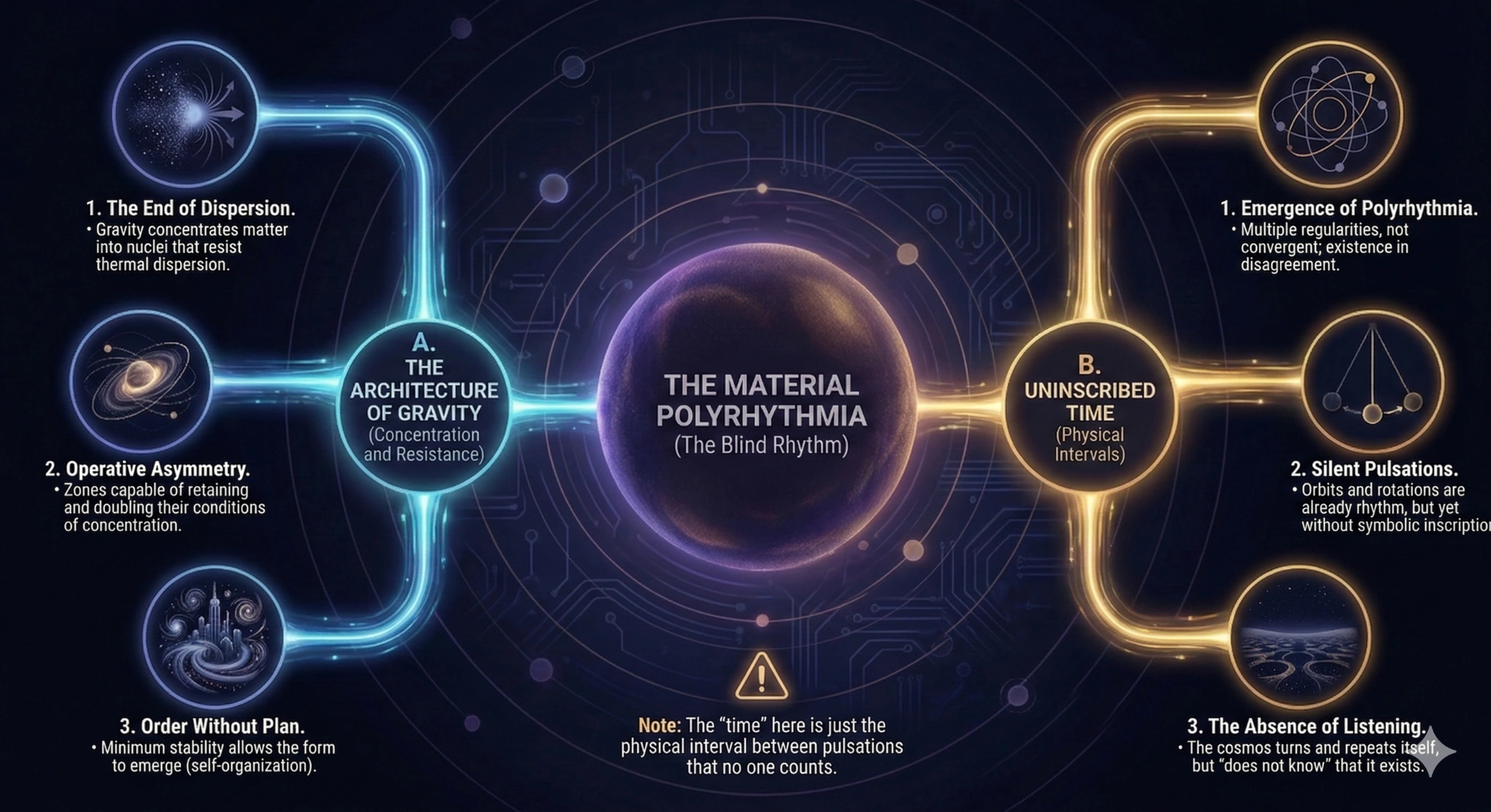
Essential Definitions
| Polyrhythm | The coexistence of multiple physical cycles (rotations, orbits) that do not converge to a central unit nor depend on global synchrony. It is the organisation by compatible divergence. |
|---|---|
| Ritmo Material | Repetition of a physical configuration (e.g. orbit) based on the reiteration of dynamic conditions, devoid of any counting, psychological memory or symbolic inscription. |
| Minimum Stability | The condition of resistance to thermal dispersion that precedes the form. A nucleus of matter only takes shape if it first manages to stabilize its gravitational concentration. |
| Time (Negative Definition) | In this text, time is defined by what is missing: it is the symbolic inscription of difference. Without a symbol, cyclical movement remains "mute" and does not constitute time in the phenomenological sense. |
| Reorganisation Nuclei | Zones of density where gravity overcomes dispersion, allowing the formation of complex structures (stars, galaxies) from excess material. |